
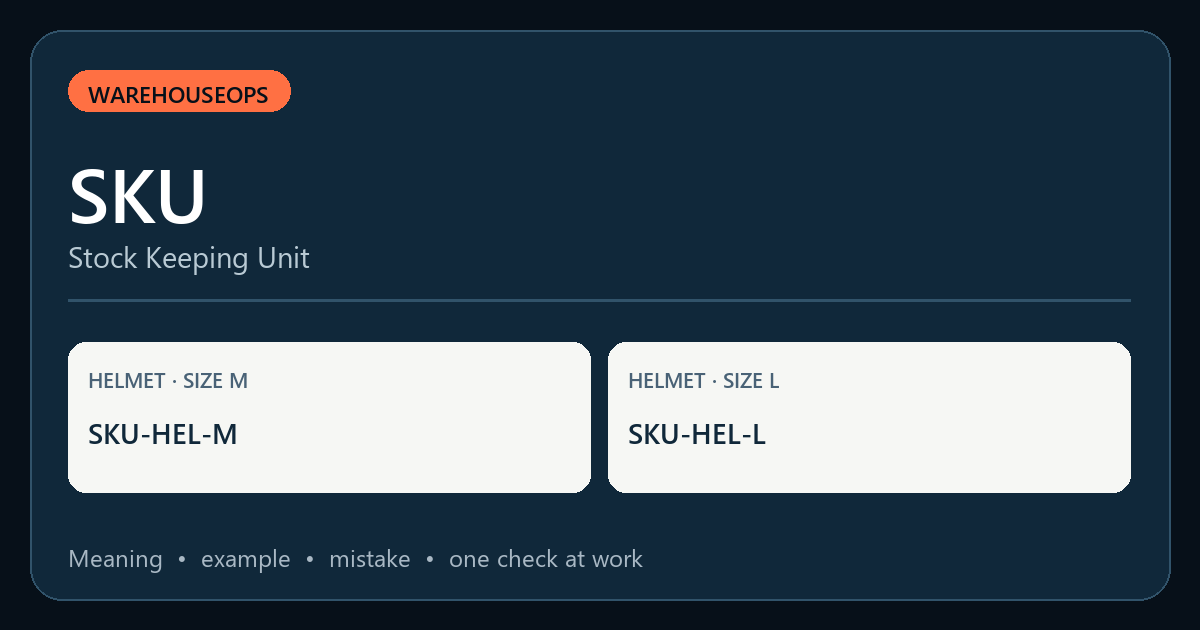
What does SKU mean?
An SKU is an internal identifier for one distinct item you need to stock, count, pick or replenish.
The exact field names and approval steps vary by warehouse. Use your site procedure when applying the idea.
A practical warehouse example
A warehouse receives 20 blue helmets in size M and 20 in size L. Both are called “blue helmet”, but they cannot share one SKU: a customer ordering size M must not receive size L.
If the warehouse also sells a sealed pack of ten helmets, that pack may need its own stock record and unit conversion. Define the stock unit before counting or pricing it.
How to apply it
- Describe the exact item
Record its product, size, colour, pack quantity and any specification that changes what a customer can order.
- Assign one stable code
Use a unique code for that distinct stockable item; do not reuse an old code for a different item.
- Verify the physical label
Compare the code and description on a sample item with the system record and the pick document.
Common mistake
A product name is not a reliable SKU. A barcode is a way to scan an identifier; it does not by itself prove that two variants are the same stock item.
Check your understanding
Can size M and size L helmets use one SKU if they are both blue?
Show the answer
No. Size changes which item must be picked, so the variants need distinct stock records.
One check to perform at work
Choose five similar items and confirm each sellable variant has a distinct code, description and stock unit. Correct duplicates through your approved master-data process.
Continue learning
Prepared by WarehouseOps · Published 2026-11-01 · Editorial and corrections policy · Suggest a correction. This is an educational example; apply the approved procedure and competent advice for your site.