
Start from scratch
Warehouse and logistics dictionary
Plain-language explanations for 67 terms used in warehousing, logistics, procurement, safety and compliance. Search a word, select a subject and open any card for a practical example.
Five useful starting points
Learn the term, then test it at work
Each explanation includes an illustrated example, a common mistake and a quick question.
Learning map
How the five subjects connect
Warehousing controls where goods are received, stored, counted, picked and packed.
Real-world visual explanations
See the ideas in an actual warehouse
Each photograph shows the physical activity behind a group of dictionary terms. Select the matching subject below to continue learning.




Learn each term properly
Every card answers five beginner questions
Open a term to see its plain meaning, operational importance, a realistic example, a common mistake and one check you can perform at work.
- MeaningWhat the word actually describes
- ImportanceWhy the operation uses it
- ExampleHow it appears in real work
- MistakeWhat beginners often misunderstand
- ActionHow to check it in your warehouse
SKUStock Keeping UnitWarehousing
1. What it means
A unique code used to identify one distinct inventory item.
2. Why it matters
A product name can cover several variants; one SKU must identify only one exact sellable or stockable item.
3. Real working example
A blue safety helmet in size M and the same helmet in size L should have different SKUs.
4. Common mistake
Using one SKU for different sizes, colours, packs or specifications.
5. Try this at work
Pick five similar items and confirm that each variant has its own code and description.
Bin locationStorage addressWarehousing
1. What it means
The coded position where stock is stored inside a warehouse.
2. Why it matters
A reliable address lets people and systems find stock without depending on memory.
3. Real working example
A-03-02-B can mean aisle A, bay 3, level 2, position B.
4. Common mistake
Treating a rack, aisle or informal nickname as a complete location address.
5. Try this at work
Choose one location and confirm its aisle, bay, level and position are labelled and recorded.
PutawayMove received goods to storageWarehousing
1. What it means
The controlled movement of accepted stock from receiving to its assigned location.
2. Why it matters
Fast, confirmed putaway prevents congestion at receiving and makes accepted stock available.
3. Real working example
After quantity and damage checks, the WMS sends a pallet to rack location B-12-03.
4. Common mistake
Moving stock physically but failing to confirm the destination in the system.
5. Try this at work
Trace one received pallet from acceptance to its final scanned storage location.
PickingCollect goods for an orderWarehousing
1. What it means
The activity of taking the correct item and quantity from storage for an order.
2. Why it matters
Picking accuracy directly affects customer service, returns and rework.
3. Real working example
A picker scans SKU 10025 and collects six units for a customer order.
4. Common mistake
Measuring speed while ignoring wrong-item, wrong-quantity and wrong-batch errors.
5. Try this at work
Observe one order and verify item, quantity, batch and confirmation at the pick location.
PackingPrepare picked goods for shipmentWarehousing
1. What it means
Checking, protecting, labelling and documenting goods before dispatch.
2. Why it matters
Packing protects the product and creates the final evidence before dispatch.
3. Real working example
Fragile parts receive cushioning, a shipping label and a final quantity check.
4. Common mistake
Treating packing as only placing goods in a box.
5. Try this at work
Check one packed order for quantity, protection, label, documents and tamper control.
Cycle countRegular partial inventory countWarehousing
1. What it means
Counting selected items or locations on a schedule instead of stopping for one complete annual count.
2. Why it matters
Regular counting detects process failures before they become a large year-end adjustment.
3. Real working example
The team counts fast-moving A items weekly and investigates every difference.
4. Common mistake
Correcting the balance without investigating why the difference occurred.
5. Try this at work
Review the last five variances and confirm each has a recorded cause and action.
Inventory accuracyMatch between records and physical stockWarehousing
1. What it means
The degree to which system quantities, locations and status agree with what physically exists.
2. Why it matters
Planning and customer promises are unreliable when system stock differs from usable physical stock.
3. Real working example
The system shows 100 units and the verified physical count is also 100.
4. Common mistake
Reporting accuracy only by number of lines and ignoring high-value quantity errors.
5. Try this at work
Compare system quantity, physical quantity, location and stock status for a sample.
FIFOFirst In, First OutWarehousing
1. What it means
A stock-rotation rule that issues the oldest eligible receipt first.
2. Why it matters
FIFO limits ageing where receipt date is the correct issue priority.
3. Real working example
Cartons received on 1 June are issued before identical cartons received on 10 June.
4. Common mistake
Assuming FIFO is suitable for every item, especially expiry-controlled goods.
5. Try this at work
Check whether the oldest eligible receipt is physically accessible and issued first.
FEFOFirst Expired, First OutWarehousing
1. What it means
A stock-rotation rule that issues the eligible batch with the earliest expiry first.
2. Why it matters
FEFO reduces expiry loss by using remaining shelf life rather than receipt date.
3. Real working example
A batch expiring in August is issued before a batch received earlier but expiring in October.
4. Common mistake
Confusing the oldest receipt with the earliest expiry.
5. Try this at work
Compare two batches and confirm the nearer expiry is allocated first.
Cross-dockingMove inbound goods directly to outbound flowWarehousing
1. What it means
Transferring goods from receiving to dispatch with little or no storage.
2. Why it matters
Cross-docking can reduce storage and handling when inbound and outbound flows are synchronised.
3. Real working example
A store-specific pallet is received in the morning and loaded onto the store vehicle the same day.
4. Common mistake
Calling any fast putaway and picking process cross-docking.
5. Try this at work
Trace whether a nominated inbound load moves directly to a known outbound demand.
Dock-to-stock timeTime from arrival to available inventoryWarehousing
1. What it means
Elapsed time from vehicle arrival or unloading until stock is ready for use or picking.
2. Why it matters
This measure reveals delay across unloading, checking, acceptance and putaway.
3. Real working example
A truck arrives at 09:00 and accepted stock becomes available at 11:00: two hours.
4. Common mistake
Starting and stopping the clock differently between sites or shifts.
5. Try this at work
Write the exact start event, end event and treatment of rejected stock.
WMSWarehouse Management SystemWarehousing
1. What it means
Software used to control inventory locations, status and warehouse tasks.
2. Why it matters
A WMS provides controlled locations, task instructions and transaction history.
3. Real working example
The WMS directs putaway, releases picks and records scan confirmations.
4. Common mistake
Expecting software to correct poor master data or unconfirmed physical work.
5. Try this at work
Check one movement in the WMS against the physical item, location, user and timestamp.
UOMUnit of MeasureWarehousing
1. What it means
The unit in which an item is counted, bought, stored or issued.
2. Why it matters
Correct unit conversions prevent large purchasing, receiving and picking errors.
3. Real working example
One case may contain 24 each; the conversion must be defined in the system.
4. Common mistake
Mixing each, inner, case, kilogram and pallet without controlled conversions.
5. Try this at work
Confirm the base, purchase and issue units for one item and test the conversion.
Pallet positionOne pallet-sized storage spaceWarehousing
1. What it means
A capacity unit representing a location designed for one pallet.
2. Why it matters
Pallet positions give a common unit for storage capacity and occupancy.
3. Real working example
A rack with 10 bays, 4 levels and 2 positions per level has 80 theoretical positions.
4. Common mistake
Counting every theoretical position as safely and operationally usable.
5. Try this at work
Separate theoretical, blocked, damaged, reserved and usable positions.
3PLThird-Party Logistics providerLogistics
1. What it means
An external company that performs logistics activities for another business.
2. Why it matters
A clear 3PL scope connects outsourced work to service, cost, data and control ownership.
3. Real working example
A manufacturer hires a 3PL to store inventory and deliver customer orders.
4. Common mistake
Choosing a provider on price without defining volumes, exceptions and responsibilities.
5. Try this at work
Take one 3PL activity and identify its owner, KPI, evidence and escalation route.
FTLFull TruckloadLogistics
1. What it means
A road shipment using most or all of one vehicle for one shipper movement.
2. Why it matters
FTL may offer direct movement and lower handling when a shipment fills most of a vehicle.
3. Real working example
Twenty pallets move directly from one factory to one distribution centre.
4. Common mistake
Assuming a dedicated vehicle is automatically full or lowest-cost.
5. Try this at work
Compare utilised weight, utilised volume, transit time and total trip cost.
LTLLess Than TruckloadLogistics
1. What it means
A shipment sharing vehicle capacity with freight from other shippers.
2. Why it matters
LTL combines smaller shipments but introduces consolidation, handling and transit considerations.
3. Real working example
Two pallets are consolidated with other customers’ freight.
4. Common mistake
Comparing only the freight rate and ignoring minimums, transfers and damage exposure.
5. Try this at work
Review one quote for minimum charge, handling points, transit and accessorial charges.
TATTurnaround TimeLogistics
1. What it means
Total time taken to complete a defined activity from start to finish.
2. Why it matters
Turnaround time exposes waiting and process delay at a facility or activity.
3. Real working example
A vehicle checks in at 10:00 and exits at 12:30, giving a 2.5-hour TAT.
4. Common mistake
Using TAT without defining the start and finish events.
5. Try this at work
Timestamp vehicle arrival, gate-in, dock-in, dock-out and gate-out for one load.
ETAEstimated Time of ArrivalLogistics
1. What it means
The current expected arrival time of a vehicle or shipment.
2. Why it matters
ETA helps teams plan docks, labour, customer communication and exceptions.
3. Real working example
The carrier updates the ETA from 14:00 to 16:00 after a road delay.
4. Common mistake
Treating an estimate as a guaranteed arrival time.
5. Try this at work
Record the ETA source, update time and actual arrival, then measure forecast error.
PODProof of DeliveryLogistics
1. What it means
Evidence that a shipment was delivered, showing receiver, date, quantity, condition and exceptions as applicable.
2. Why it matters
POD supports delivery confirmation, billing and claims resolution.
3. Real working example
The receiver signs for nine cartons and records one damaged carton.
4. Common mistake
Accepting an unreadable signature or photo without order, date and exception details.
5. Try this at work
Open one POD and verify consignee, order, time, quantity status and remarks.
OTIFOn Time In FullLogistics
1. What it means
A service measure showing whether an order arrived by the agreed time and with the complete required quantity.
2. Why it matters
OTIF measures whether the same order met both the promised date and complete quantity.
3. Real working example
An order promised for Friday arrives Friday with all 50 units, so it is OTIF.
4. Common mistake
Multiplying the on-time percentage by the in-full percentage.
5. Try this at work
Select ten orders and test both conditions on each order separately.
ConsignmentGoods sent under one transport movementLogistics
1. What it means
A shipment given to a carrier for delivery from a sender to a receiver.
2. Why it matters
A consignment groups goods under a defined transport movement and documentation set.
3. Real working example
Three pallets covered by one transport document form one consignment.
4. Common mistake
Using consignment, order, shipment and delivery as if they always mean the same unit.
5. Try this at work
Match one consignment number to its packages, documents, route and consignee.
Freight forwarderTransport organiserLogistics
1. What it means
A company that arranges transport, documents and related services, often using other carriers.
2. Why it matters
A forwarder coordinates transport, carriers and documentation across a movement.
3. Real working example
A forwarder books ocean space and coordinates customs documents for an exporter.
4. Common mistake
Assuming the forwarder is always the physical carrier or customs authority.
5. Try this at work
Identify the contracting party, actual carrier, broker and responsibility at each leg.
Last mileFinal delivery stageLogistics
1. What it means
The movement from a local distribution point to the final customer or destination.
2. Why it matters
The final stage often carries high cost and customer-experience risk.
3. Real working example
A parcel travels from a city hub to the customer’s home.
4. Common mistake
Measuring dispatch performance but ignoring failed delivery and reattempts.
5. Try this at work
Review first-attempt delivery, reason codes, proof and re-delivery cost.
Lead timeTime between request and availabilityLogistics
1. What it means
Elapsed time from an agreed starting event, such as order placement, to receipt or readiness.
2. Why it matters
Lead time determines when replenishment must start and how much uncertainty must be covered.
3. Real working example
An order placed Monday and received Friday has a four-day calendar lead time.
4. Common mistake
Using one average without defining events or examining variability.
5. Try this at work
Measure order-to-delivery lead time for recent orders and show the range, not only average.
Reverse logisticsFlow of goods back from the userLogistics
1. What it means
Managing returns, repair, recall, recycling or disposal after delivery.
2. Why it matters
Returns require controlled receipt, condition decision, value recovery and traceability.
3. Real working example
A defective appliance returns for inspection and authorised refurbishment.
4. Common mistake
Putting returned goods directly back into saleable stock.
5. Try this at work
Trace one return through authorisation, receipt, inspection, disposition and credit.
Load planningArrange freight safely and efficientlyLogistics
1. What it means
Deciding position, sequence, weight distribution and restraint of goods in a vehicle or container.
2. Why it matters
Good planning protects stability, legal weight, product condition and unloading sequence.
3. Real working example
Heavy pallets are placed according to the approved axle and restraint plan.
4. Common mistake
Planning only by floor space and ignoring axle weight, height, restraint or delivery order.
5. Try this at work
Check one load for weight, dimensions, centre of gravity, restraint and stop sequence.
PRPurchase RequisitionProcurement
1. What it means
An internal request asking the organisation to buy specified goods or services.
2. Why it matters
A purchase requisition documents an internal need before a commercial commitment is made.
3. Real working example
Maintenance raises a PR for ten replacement bearings.
4. Common mistake
Treating a PR as an order that can be sent to a supplier.
5. Try this at work
Check one PR for specification, quantity, need date, cost centre and approval.
RFQRequest for QuotationProcurement
1. What it means
A structured request asking suppliers to provide price, delivery and commercial terms for a defined requirement.
2. Why it matters
An RFQ creates comparable commercial offers when the need is already clear.
3. Real working example
Three approved suppliers quote for 500 identical cartons.
4. Common mistake
Sending different scope or volume information to different bidders.
5. Try this at work
Confirm every bidder received the same specification, quantities and pricing template.
RFPRequest for ProposalProcurement
1. What it means
A request asking suppliers to propose a solution where approach and capability matter as well as price.
2. Why it matters
An RFP evaluates solutions and capability where suppliers may propose different approaches.
3. Real working example
A company asks providers to design and operate a new distribution centre.
4. Common mistake
Using an RFP when only a simple price quotation is required.
5. Try this at work
Separate mandatory requirements, solution questions, evaluation weights and commercial response.
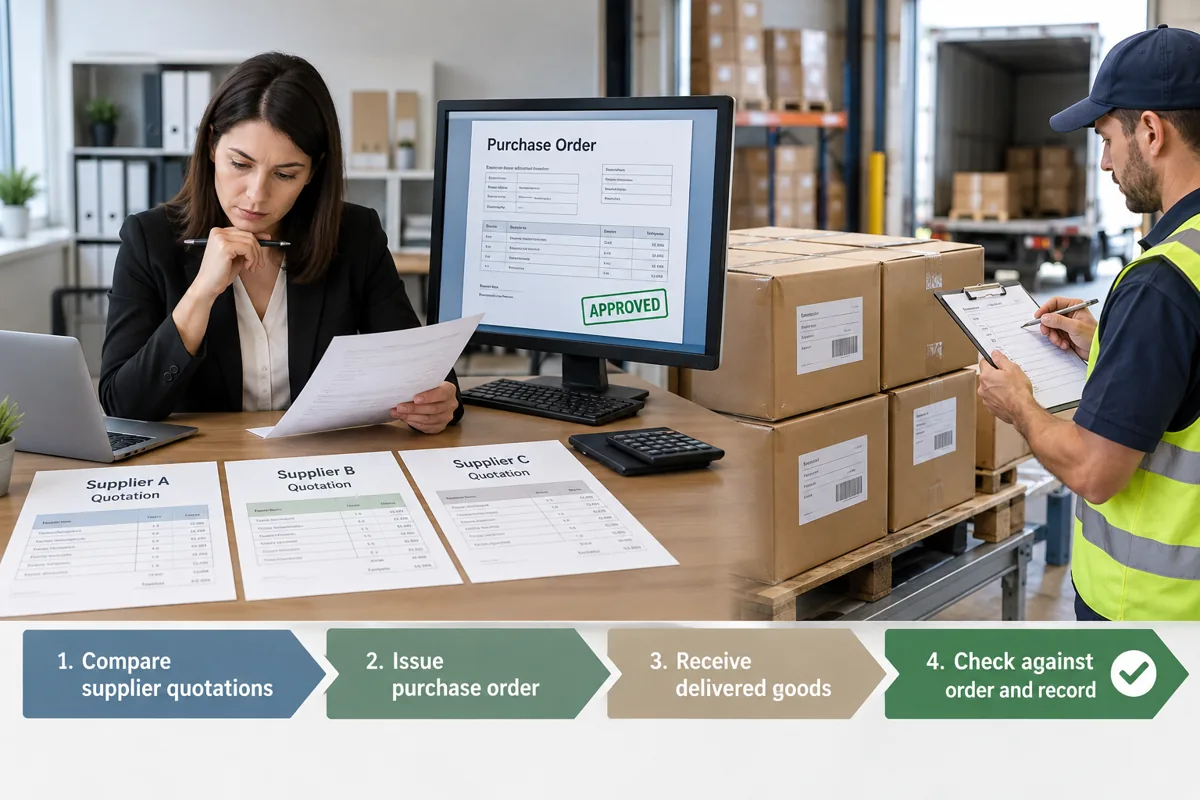
POPurchase OrderProcurement
1. What it means
A formal buyer document authorising specified goods or services at agreed terms.
2. Why it matters
A purchase order records the authorised commercial commitment to a supplier.
3. Real working example
The PO states SKU, quantity, price, delivery date and location.
4. Common mistake
Changing quantity, price or delivery terms informally without updating the PO.
5. Try this at work
Match one PO to approval, supplier acknowledgement and the latest agreed terms.
GRNGoods Receipt NoteProcurement
1. What it means
A record confirming what was physically received and accepted, including discrepancies.
2. Why it matters
The GRN records what was actually received and accepted, supporting stock and payment controls.
3. Real working example
The GRN records 98 accepted units against a PO for 100.
4. Common mistake
Creating a GRN for the ordered quantity instead of the verified receipt.
5. Try this at work
Compare one GRN with physical receipt evidence, shortage, damage and acceptance status.
Three-way matchPO, receipt and invoice comparisonProcurement
1. What it means
A payment control comparing what was ordered, what was received and what was invoiced.
2. Why it matters
Matching prevents payment for unapproved, undelivered or incorrectly invoiced goods.
3. Real working example
The invoice for 100 units is held because the GRN shows only 98 accepted.
4. Common mistake
Forcing differences to match without an approved tolerance or investigation.
5. Try this at work
Compare one PO, GRN and invoice line by line for item, quantity, price and tax.
MOQMinimum Order QuantityProcurement
1. What it means
The smallest quantity a supplier will accept for one order or production run.
2. Why it matters
MOQ affects order feasibility, stock investment and ageing risk.
3. Real working example
A supplier requires at least 500 printed boxes per order.
4. Common mistake
Entering MOQ as the planned order quantity without checking demand and pack multiples.
5. Try this at work
Compare MOQ with average demand, shelf life, storage and supplier pack size.
EOQEconomic Order QuantityProcurement
1. What it means
A calculated order quantity that balances relevant ordering and inventory-holding costs under stated assumptions.
2. Why it matters
EOQ illustrates the trade-off between ordering frequency and holding inventory.
3. Real working example
A buyer compares frequent small orders with fewer large orders using verified cost inputs.
4. Common mistake
Treating the calculated quantity as mandatory despite MOQ, packs, expiry or discounts.
5. Try this at work
Calculate adjacent feasible quantities and compare total relevant cost and constraints.
Landed costTotal cost to bring goods to the required locationProcurement
1. What it means
Purchase price plus applicable freight, duty, insurance, handling and other defined acquisition costs.
2. Why it matters
Landed cost enables a fair sourcing comparison beyond supplier price.
3. Real working example
A ₹100 item may have a ₹118 landed cost after freight and duty.
4. Common mistake
Leaving out freight, duty, handling, insurance or non-recoverable taxes.
5. Try this at work
Reconcile one import from purchase value through every cost to cost per usable unit.
IncotermsICC trade terms for delivery responsibilitiesProcurement
1. What it means
Standard rules defining selected buyer and seller responsibilities, costs and risks in international trade contracts.
2. Why it matters
The chosen rule allocates delivery tasks, cost and risk between seller and buyer.
3. Real working example
The contract names the chosen Incoterms rule, place and version.
4. Common mistake
Believing Incoterms decide ownership, payment terms or every contractual issue.
5. Try this at work
Record the rule, named place and version, then map cost and risk handover.
Supplier lead timeTime from supplier order to agreed delivery eventProcurement
1. What it means
The measured time between order release and receipt or another defined milestone.
2. Why it matters
Supplier lead time affects reorder timing, service risk and buffer design.
3. Real working example
A supplier normally delivers 14 calendar days after confirmed PO receipt.
4. Common mistake
Measuring from different events or excluding late and incomplete orders.
5. Try this at work
Compare PO release, supplier confirmation, dispatch, arrival and availability dates.
Safety stockInventory buffer for uncertaintyProcurement
1. What it means
Extra stock held to protect service against defined demand or supply variability.
2. Why it matters
Safety stock protects service against defined demand or lead-time uncertainty.
3. Real working example
A planner holds a verified buffer for variable demand during replenishment.
4. Common mistake
Using a fixed percentage without connecting it to variability and desired service.
5. Try this at work
Identify the uncertainty being covered and test how the buffer changes with it.
Reorder pointInventory position that triggers replenishmentProcurement
1. What it means
A trigger normally based on expected demand during lead time plus an approved buffer.
2. Why it matters
The reorder point signals when available supply may no longer cover demand through replenishment.
3. Real working example
When inventory position reaches 120 units, the system creates a replenishment proposal.
4. Common mistake
Using on-hand stock only and ignoring open supply, allocations or backorders.
5. Try this at work
Define inventory position and test one item using demand during lead time plus buffer.
HazardSource with potential to cause harmSafety
1. What it means
Something that could injure people, damage health, property or the environment.
2. Why it matters
Naming the source of harm is the first step toward selecting an effective control.
3. Real working example
A moving forklift in a shared pedestrian aisle is a hazard.
4. Common mistake
Writing only “unsafe” or “risk” without identifying what can cause harm.
5. Try this at work
During a walk, state the source, who may be harmed and the credible event.
RiskCombination of likelihood and consequenceSafety
1. What it means
The evaluated chance that a hazard will cause harm and how severe that harm could be.
2. Why it matters
Risk assessment helps prioritise action using likelihood, consequence and existing controls.
3. Real working example
A blind crossing used frequently by forklifts may have high collision risk.
4. Common mistake
Treating a risk score as proof that the work is safe.
5. Try this at work
Check whether the rating reflects current controls and whether stronger controls are possible.
PPEPersonal Protective EquipmentSafety
1. What it means
Equipment worn to reduce exposure after higher-level controls have been considered.
2. Why it matters
PPE can reduce exposure when correctly selected, fitted, used and maintained.
3. Real working example
Safety footwear and eye protection are selected for the assessed task.
4. Common mistake
Using PPE as the first or only control when the hazard can be removed or isolated.
5. Try this at work
For one task, confirm PPE suitability, fit, condition, training and replacement.
SDSSafety Data SheetSafety
1. What it means
Supplier information describing chemical hazards, handling, storage, exposure controls and emergency measures.
2. Why it matters
An SDS explains chemical hazards, handling, storage, exposure and emergency measures.
3. Real working example
The spill team checks the current SDS before selecting response equipment.
4. Common mistake
Keeping an outdated sheet that workers cannot access or understand.
5. Try this at work
Find the current SDS for one chemical and verify its identity, language and emergency details.
Near missUnplanned event without injury or damage this timeSafety
1. What it means
An event that could reasonably have caused harm and should be investigated for learning.
2. Why it matters
Near misses reveal failed or weak controls before a more serious outcome occurs.
3. Real working example
A pallet falls into an empty aisle seconds after a person leaves it.
4. Common mistake
Recording the event but closing it after only reminding the worker.
5. Try this at work
Reconstruct one event, identify the failed control and verify the corrective action.
LOTOLockout/TagoutSafety
1. What it means
A controlled process for isolating hazardous energy before work and preventing unexpected re-energisation.
2. Why it matters
LOTO prevents unexpected energy release during maintenance or access.
3. Real working example
A technician isolates, locks and verifies zero energy before entering machinery.
4. Common mistake
Switching equipment off without isolating, locking and verifying every energy source.
5. Try this at work
Ask the authorised person to demonstrate isolation points and zero-energy verification.
PTWPermit to WorkSafety
1. What it means
A documented authorisation controlling specified high-risk work for a defined place and time.
2. Why it matters
A permit coordinates hazards, controls, authorisation and handback for defined high-risk work.
3. Real working example
Hot work starts only after the permit, isolations and fire precautions are verified.
4. Common mistake
Treating the signed form as the control instead of verifying conditions in the field.
5. Try this at work
Check one live permit against location, time, isolation, precautions and handback.
SWLSafe Working LoadSafety
1. What it means
The maximum load equipment is authorised to handle under specified conditions.
2. Why it matters
SWL prevents equipment or accessories being loaded beyond approved capability.
3. Real working example
A lifting accessory marked 1 tonne must not be used for a 1.2-tonne load.
4. Common mistake
Assuming all parts of a lifting system have the same capacity.
5. Try this at work
Verify markings and certificates for the equipment and every accessory in the lift.
BanksmanTrained vehicle-movement guideSafety
1. What it means
A designated person who guides a vehicle or equipment movement under the site procedure.
2. Why it matters
A trained guide controls communication and blind spots during vehicle movement.
3. Real working example
The driver stops when the banksman is no longer visible.
4. Common mistake
Using any nearby worker without a defined signal system or safe position.
5. Try this at work
Observe whether the driver stops immediately when visual contact is lost.
Hierarchy of controlsPreferred order for reducing riskSafety
1. What it means
A sequence prioritising elimination, substitution and engineering controls before administrative controls and PPE.
2. Why it matters
The hierarchy encourages controls that remove or isolate danger before relying on behaviour.
3. Real working example
Separating pedestrians with barriers is stronger than relying only on warning signs.
4. Common mistake
Jumping directly to training, signs or PPE.
5. Try this at work
For one hazard, document why elimination, substitution and engineering controls were or were not feasible.
CAPACorrective and Preventive ActionSafety
1. What it means
A structured method to correct a problem, address its causes and verify that recurrence is prevented.
2. Why it matters
CAPA connects containment, root cause, corrective action and proof that recurrence is controlled.
3. Real working example
After repeat rack impacts, the site changes layout, installs protection and checks effectiveness.
4. Common mistake
Closing an action when installed instead of checking whether it worked.
5. Try this at work
Open one CAPA and verify owner, due date, cause, evidence and effectiveness review.
Emergency evacuationControlled movement to a safe placeSafety
1. What it means
The planned response for people to leave or move to safety during an emergency.
2. Why it matters
A planned evacuation protects people who must leave or move to safety under pressure.
3. Real working example
On hearing the alarm, workers follow the marked route to the assembly point.
4. Common mistake
Assuming an alarm and exit signs are enough without drills or accountability.
5. Try this at work
Walk the route and test alarm recognition, exits, assembly, roll call and assistance needs.
Fire loadPotential heat energy from combustible materialSafety
1. What it means
The amount and type of combustible contents that can contribute to fire severity.
2. Why it matters
Fire load influences prevention, detection, suppression and separation decisions.
3. Real working example
Cardboard, plastic packaging and stored chemicals affect the assessed fire load.
4. Common mistake
Considering only quantity while ignoring material type, packaging and storage arrangement.
5. Try this at work
Review combustibles in one zone and compare them with the approved fire strategy.
Compliance registerList of applicable obligations and controlsCompliance
1. What it means
A maintained record of licences, legal duties, standards, owners, evidence and review dates.
2. Why it matters
A register turns obligations into owners, dates, evidence and monitored actions.
3. Real working example
The register shows the fire approval owner, expiry date and renewal evidence.
4. Common mistake
Keeping a licence list without conditions, renewals or operational controls.
5. Try this at work
Select one obligation and verify authority, applicability, owner, evidence and next review.
Fire NOCFire authority approval commonly called No Objection CertificateCompliance
1. What it means
A jurisdiction-specific fire-safety approval or clearance whose exact name and process depend on the local authority.
2. Why it matters
Fire approval helps confirm that applicable fire-safety requirements have been addressed.
3. Real working example
A warehouse checks its state fire service portal for the applicable approval and renewal steps.
4. Common mistake
Assuming one approval name or process applies throughout India.
5. Try this at work
Check the current local authority portal, approval conditions, validity and renewal status.
FSSAIFood Safety and Standards Authority of IndiaCompliance
1. What it means
India’s food regulator; relevant food businesses must determine the licence or registration applicable to their activity.
2. Why it matters
Food activities may require registration or licensing plus continuing hygiene and record controls.
3. Real working example
A food warehouse verifies its business category, capacity and licence conditions before operating.
4. Common mistake
Obtaining a licence but ignoring its scope, address, product or operating conditions.
5. Try this at work
Match the licence details to the actual activity, premises and current validity.
PESOPetroleum and Explosives Safety OrganisationCompliance
1. What it means
Indian authority administering specified controls for petroleum, explosives, compressed gases and related hazardous materials.
2. Why it matters
Specified petroleum, explosive and compressed-gas activities require specialised controls and approvals.
3. Real working example
A facility planning regulated petroleum storage checks the applicable PESO approval before installation.
4. Common mistake
Ordering or installing regulated storage before confirming approval requirements.
5. Try this at work
List material, quantity, container and layout, then confirm applicability with official guidance.
SPCBState Pollution Control BoardCompliance
1. What it means
The state authority administering specified pollution-control consents and environmental requirements.
2. Why it matters
Pollution-control requirements may apply to establishment, operation, waste, emissions or discharge.
3. Real working example
A facility checks whether Consent to Establish or Consent to Operate applies to its activity.
4. Common mistake
Assuming a warehouse has no environmental obligations because it does not manufacture.
5. Try this at work
Review activities, generators, batteries, waste, discharge and the state consent position.
EPRExtended Producer ResponsibilityCompliance
1. What it means
A policy approach making identified producers responsible for specified post-consumer product or packaging obligations.
2. Why it matters
EPR assigns specified post-consumer obligations to identified producers and brand owners.
3. Real working example
An obligated business records packaging data and follows the applicable portal and recycling requirements.
4. Common mistake
Assuming the warehouse operator automatically owns every EPR obligation.
5. Try this at work
Identify the obligated legal entity, material category, reporting data and authorised channel.
Legal MetrologyRules for weights, measures and packaged commoditiesCompliance
1. What it means
Indian requirements covering specified measuring instruments, declarations and packaged goods.
2. Why it matters
Accurate measures and packaged declarations protect trade and customers.
3. Real working example
A warehouse verifies that a trade weighing scale has the required verification status.
4. Common mistake
Using an unverified trade scale or overlooking required package declarations.
5. Try this at work
Check one scale and one packaged product for current verification and required markings.
GSTGoods and Services TaxCompliance
1. What it means
India’s indirect tax system affecting registration, invoices and movement documentation.
2. Why it matters
Correct tax and movement documents support lawful dispatch and accounting.
3. Real working example
The dispatch team checks the tax invoice and applicable e-way bill before vehicle release.
4. Common mistake
Treating the warehouse as responsible for deciding tax treatment without authorised guidance.
5. Try this at work
Verify one dispatch has the approved invoice and, where applicable, valid e-way bill.
IECImporter Exporter CodeCompliance
1. What it means
An identifier generally required for importing or exporting goods from India, issued through DGFT.
2. Why it matters
IEC identifies an Indian importer or exporter for most commercial cross-border activity.
3. Real working example
A business obtains and maintains its IEC before regular commercial imports.
4. Common mistake
Treating IEC as product approval or customs clearance by itself.
5. Try this at work
Match the IEC holder to the contracting entity and confirm current DGFT details.
Audit trailTraceable history of actions and changesCompliance
1. What it means
Evidence showing who performed or changed something, what changed and when.
2. Why it matters
A reliable history supports investigation, accountability and data integrity.
3. Real working example
The WMS records the user, time, old quantity, new quantity and reason code.
4. Common mistake
Allowing shared user IDs or editable logs that cannot show the original value.
5. Try this at work
Trace one adjustment to user, time, before value, after value, reason and approval.
Record retentionKeeping evidence for a defined periodCompliance
1. What it means
A documented rule for preserving records based on legal, contractual and business requirements.
2. Why it matters
Retention rules keep evidence available for legal, contractual and operational needs.
3. Real working example
Training records are retained according to the approved retention schedule.
4. Common mistake
Keeping everything forever or deleting records without an approved schedule.
5. Try this at work
Select one record type and verify period, owner, storage, access and secure disposal.
TraceabilityAbility to follow history and movementCompliance
1. What it means
The capability to trace an item, batch or activity backward and forward through recorded events.
2. Why it matters
Traceability enables rapid containment, investigation and recall.
3. Real working example
A batch can be traced from supplier receipt to every customer delivery.
4. Common mistake
Recording receipts and dispatches without linking the same batch or serial identity.
5. Try this at work
Choose one batch and trace backward to supplier and forward to every recipient.
QuarantineControlled status preventing unauthorised useCompliance
1. What it means
Physical and system separation of goods pending an authorised decision.
2. Why it matters
Quarantine prevents uncertain or rejected stock from accidental use or shipment.
3. Real working example
Damaged cartons are labelled, blocked in the WMS and moved to a controlled area.
4. Common mistake
Relying only on floor tape while the stock remains available in the system.
5. Try this at work
Confirm physical identification, access control, system block, owner and disposition.
Competent personPerson with suitable knowledge, skill and experienceCompliance
1. What it means
Someone capable of performing the assigned assessment or task within the applicable requirement.
2. Why it matters
Some decisions require proven knowledge, skill, experience and authority.
3. Real working example
A qualified rack inspector assesses damage before the bay returns to service.
4. Common mistake
Assigning competence from job title alone without checking the specific task.
5. Try this at work
Record the task, required competence, evidence, limitations and reassessment date.
Trusted visual and reference learning
These external resources supplement the explanations above. Always follow current Indian law, local authority requirements, equipment instructions and your site procedure.
OSHA forklift learning tool
Forklift types, operating fundamentals, workplace conditions and training assistance.
Official video libraryIATA dangerous-goods videos
Video learning covering classification, packing, marking, documentation and handling for air transport.
Official guidanceHSE workplace transport
A visual introduction to vehicle and pedestrian risk at work.