
A practical route through WarehouseOps
Pick a warehouse problem. Leave with a floor action.
Each journey connects the idea, a small worked example, the right tool or procedure, and an action to verify on your next shift. Start with the problem closest to your work.
Choose a problemWhat needs attention today?
You can start anywhere. Each route takes about 10–20 minutes to read before the floor check.
 Inventory controllerFind and fix stock record differencesThe system says stock is available, but the picker cannot find it.
 Receiving teamReceive goods without losing the evidenceA supplier says 100 units were sent, but the receiving team finds fewer usable units.Operations supervisorImprove picking accuracy before dispatchCustomers receive the wrong item or quantity even though stock was available.
 Safety leadControl the loading dock before work startsVehicle movement, pedestrians and dock-edge exposure meet in one area.
 Safety and compliance coordinatorTurn fire readiness into a repeatable checkEquipment may be present, yet exits, drills and proof of checks are incomplete.
 Logistics and service managerAgree what an on-time, in-full delivery meansThe warehouse and customer report different delivery performance from the same orders.
01 / 06 · Inventory controller
Find and fix stock record differences
The system says stock is available, but the picker cannot find it.
Work through this example
In a sample of 20 SKU–location records, 3 physical counts differ from the system. The sample accuracy is 17 ÷ 20 = 85%. Investigate all three differences before changing stock balances.
Illustrative data for learning. Confirm your own definitions, approvals and source records before acting.
- 1Understand
Learn why item codes, locations and transaction timing matter.
Open understand resource - 2Measure
Use a controlled count and record each variance.
Open measure resource - 3Check on the floor
Follow the cycle-count procedure with recount and approval.
Open check on the floor resource - 4See a case
Trace a recurring record-accuracy problem to its control failure.
Open see a case resource
Select one busy aisle, count 20 SKU–location records, and record the three most common causes of any differences.
02 / 06 · Receiving team
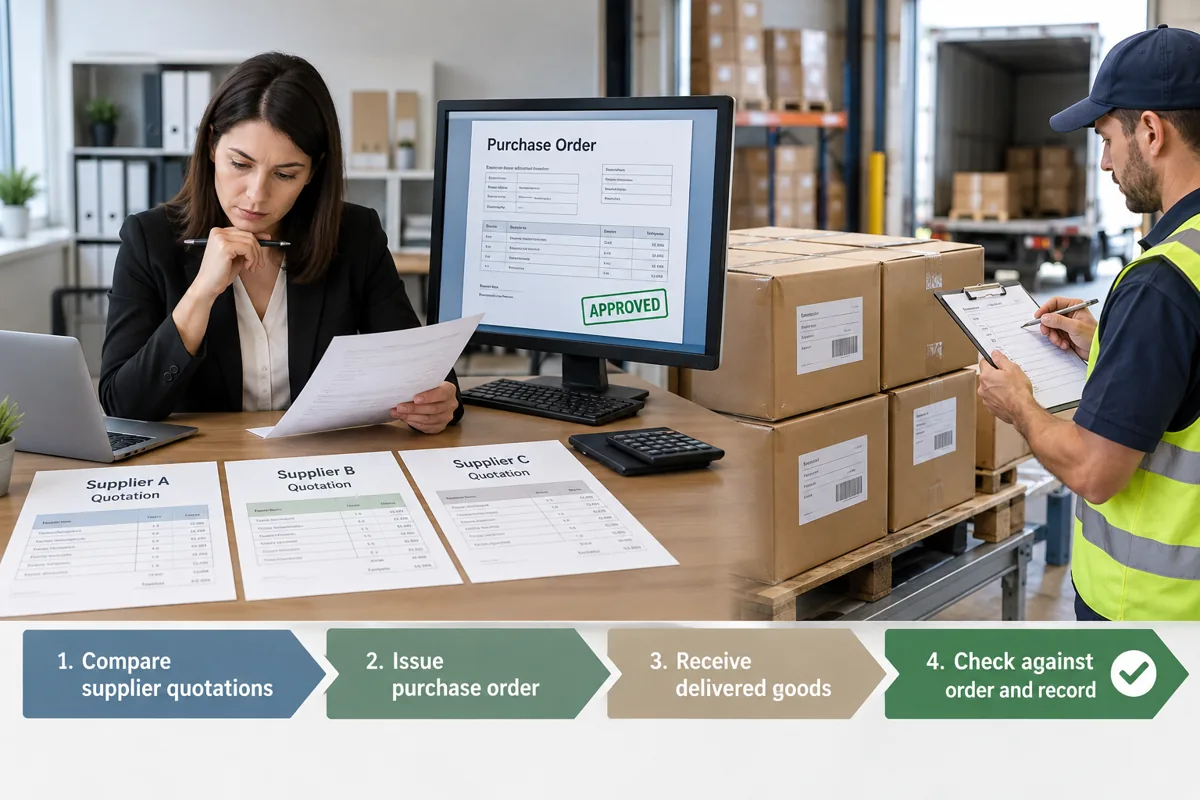
Receive goods without losing the evidence
A supplier says 100 units were sent, but the receiving team finds fewer usable units.
Work through this example
A purchase order calls for 100 units. The vehicle brings 96; 3 are damaged. Record 93 accepted units, 3 damaged units and 4 units not delivered. Keep the supplier document and exception record together.
Illustrative data for learning. Confirm your own definitions, approvals and source records before acting.
- 1Understand
Learn what a goods received note records.
Open understand resource - 2Plan
Check documents, quantities, condition and quarantine rules.
Open plan resource - 3Check on the floor
Use the receiving SOP to record shortages and damage.
Open check on the floor resource - 4Review capacity
Estimate the dock and people needed for the arrival pattern.
Open review capacity resource
Take one recent disputed delivery and reconstruct its purchase order, delivery note, count, damage evidence and system entry.
03 / 06 · Operations supervisor
Improve picking accuracy before dispatch
Customers receive the wrong item or quantity even though stock was available.
Work through this example
Out of 250 picked order lines, 238 pass the first independent check. First-pass accuracy is 238 ÷ 250 = 95.2%. Record whether the 12 failures came from the wrong SKU, location, quantity or pack.
Illustrative data for learning. Confirm your own definitions, approvals and source records before acting.
- 1Understand
Follow the movement from storage to dispatch.
Open understand resource - 2Measure
Compare picked lines and productive hours consistently.
Open measure resource - 3Check on the floor
Use the picking, packing and dispatch procedure.
Open check on the floor resource - 4Close the loop
Review whether corrections improved customer service.
Open close the loop resource
Review the next 20 picking errors by cause, shift and location before changing the process.
04 / 06 · Safety lead
Control the loading dock before work starts
Vehicle movement, pedestrians and dock-edge exposure meet in one area.
Work through this example
A vehicle arrives while a pedestrian is crossing the loading route. Stop the movement, secure the vehicle, use the designated pedestrian route and restart only when the supervisor confirms the controls.
Illustrative data for learning. Confirm your own definitions, approvals and source records before acting.
- 1Understand
Identify the vehicle, pedestrian and dock-edge hazards.
Open understand resource - 2Observe
Walk the actual route and document missing barriers or sight lines.
Open observe resource - 3Check on the floor
Use the vehicle-loading procedure and stop-work checks.
Open check on the floor resource - 4See a case
Follow a near miss from timeline to verified corrective action.
Open see a case resource
Observe one full loading cycle and note exactly when vehicle restraint and pedestrian separation are confirmed. Print the dock briefing poster for the next toolbox talk.
05 / 06 · Safety and compliance coordinator
Turn fire readiness into a repeatable check
Equipment may be present, yet exits, drills and proof of checks are incomplete.
Work through this example
A monthly walk finds one exit blocked and one extinguisher inspection overdue. Remove the obstruction immediately, record both findings, assign the inspection and verify closure with dated evidence.
Illustrative data for learning. Confirm your own definitions, approvals and source records before acting.
- 1Understand
Review warehouse fire prevention and emergency controls.
Open understand resource - 2Check on the floor
Use the evacuation procedure and assembly-point checks.
Open check on the floor resource - 3See a case
Follow a fire-readiness walkthrough and action record.
Open see a case resource - 4Track obligations
Check applicable local approvals and renewal owners.
Open track obligations resource
Walk every exit route today and test that the current site plan, contact list and drill record can be found.
06 / 06 · Logistics and service manager
Agree what an on-time, in-full delivery means
The warehouse and customer report different delivery performance from the same orders.
Work through this example
For 20 orders, 18 arrived on time and 17 arrived in full. Only 16 met both conditions on the same order. OTIF is 16 ÷ 20 = 80%; do not multiply the two separate percentages.
Illustrative data for learning. Confirm your own definitions, approvals and source records before acting.
- 1Understand
Define the promise date, quantity and proof event.
Open understand resource - 2Measure
Calculate both conditions on the same order set.
Open measure resource - 3Check evidence
Connect dispatch, carrier and proof-of-delivery records.
Open check evidence resource - 4See a case
Reconcile two conflicting OTIF reports.
Open see a case resource
Choose five disputed orders and record the promise, despatch, delivery and accepted quantity for each.